
Bolivia

I think this post about the four days I spent in Bolivia will be one of my least rambling yet, because most of the time I spent in Bolivia was just taking in the breathtaking natural landscapes.
For the overland tour from San Pedro de Atacama, Chile to Uyuni, Bolivia, I was traveling on a small group tour. A minibus drove around that morning to collect the 4 other people on my tour: a couple from Brazil and two sisters from Belgium. We left San Pedro de Atacama in Chile around 7am, heading for the border with Bolivia. We had breakfast while we waited for the border offices to open, and then transferred our luggage to a Jeep. Many of the roads in this section of Bolivia are not paved, so we had a few days of bumpy road ahead of us.

This area of the Bolivian highlands is famous for its lagoons. Our first stop was Laguna Blanca, or the White Lagoon.
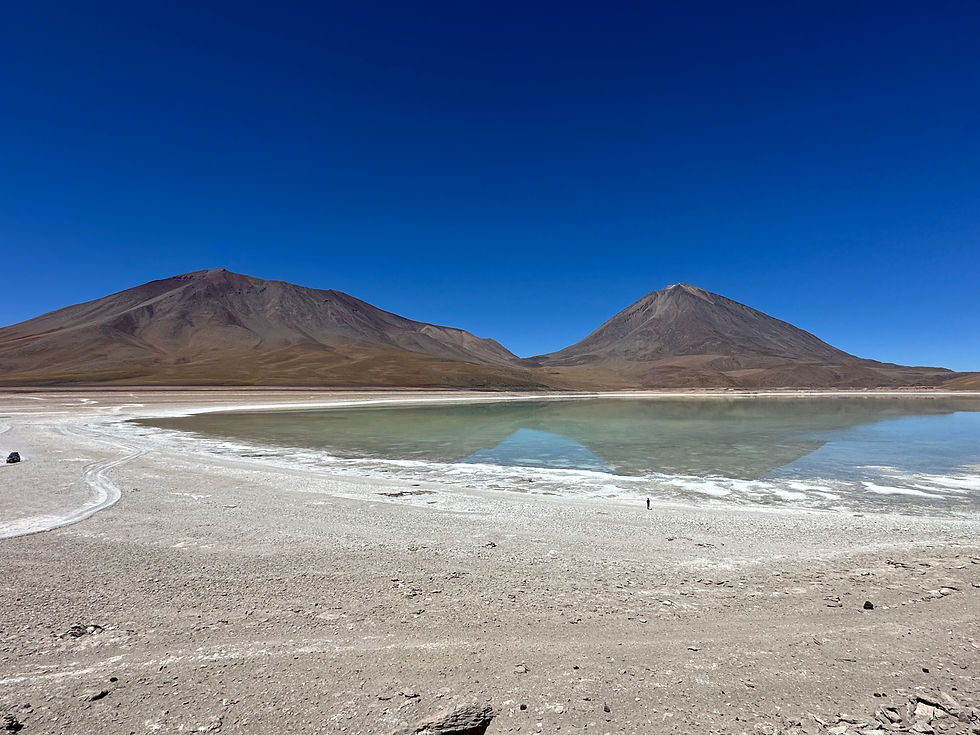
Laguna Verde, or the Green Lagoon

The isolated rock formations behind me, which were formed by wind erosion, evoke a surrealist landscape, which is why this area is called the Salvador Dalí Desert.

It was midday at this point so we stopped at Polques Hot Springs for lunch and to enjoy the thermal pools.

Later in the day, we made it to the most famous of the Bolivian lagoons: the Laguna Colorada. This is the nesting place for more than 30,000 flamingoes!

According to Wikipedia, this lagoon "gets its vivid crimson color from a combination of red-pigmented algae and red mineral sediments suspended in the shallow, highly saline water."
I know the photos make it look like this was a short day, but we were on the road for the better part of 12 hours. Around dinner time, we made it to our accommodations in Villamar Mallcu, where we ate and went to bed early, since bumping along dirt roads all day really took it out of us.

We got to sleep in a little bit in the morning, so we went for a walk in town and came across some alpacas, much to my delight.

Our first stop was in the Siloli desert, where the wind and sun have carved unique volcanic rock formations.

One of my favorite things about being on a tour like this is that there are people who will offer to take pictures of me. I have more pictures of me just in Bolivia than in the rest of my solo trip through South America combined, I think!

We had lunch close to Laguna Escondida, or the Hidden Lagoon, which is indeed tucked away among all these rock formations. You can't really see it until you're upon it.

Posing with the Anaconda River Valley

That night, we made it to the edge of the Uyuni Salt Flats, where we spent the night in a salt hotel. The bricks you can see in the wall and under the bed are all salt blocks!

In the morning, we got up at 4am and headed outside while it was still dark to see the sun rise over the salt flats.

The salt lines on the ground are respiration lines from the earth breathing. According to Wikipedia, the salt flat "was formed as a result of transformations of seven Late Pleistocene lakes whose progressive desiccation led to the accumulation of extensive evaporitic salt deposits. It is now covered by an 8-meter-thick layer of salt," which is 26 feet.

The Uyuni Salt Flat in Bolivia is also the largest in the world at 4,200 square miles.

The Isla Incahuasi was traditionally a resting place for people who used to cross the salt flats on foot. It's named an island because the salt flat was once a lake.

The Isla is covered in giant columnar cacti!

Once we came back down from getting up close and personal with the cacti, we had breakfast at a table and seats also made out of salt blocks.

I couldn't resist picking up some loose salt, just to see how big it is compared to table salt or even sea salt.

Because this area is so flat, our tour guide insisted on doing a whole photoshoot of forced perspective pictures, where we looked like we were being eaten by a dinosaur or running out of a Pringles can. Based solely on the fact that I was there by myself, I opted out of those and just insisted on one normal photo instead.

The famous off-road endurance race, the Dakar Rally, was held on the salt flats in 2014

The Plaza de las Banderas, of the Plaza of Flags, has flags from all countries who participated in the Dakar Rally.

Our tour across the Bolivian highlands ended in the town of Uyuni, where we also visited the train cemetery on the edge of town. According to Wikipedia, "Uyuni was a key transportation hub for South American trains in the late 19th century; however, the mining industry’s collapse in the 1940s halted these developments."
That was the end of our small-group tour, so I was back to solo traveling when I took an overnight bus to La Paz.
I arrived and dropped my stuff off at my hostel, then immediately headed out to take a city tour.

The tour met at Plaza San Francisco in front of the Basilica of Saint Francis, a Catholic church that was built between 1743 and 1772.

Our next stop was a visit to the Witches Market, which is run by witch doctors who sell potions, medicinal plants, dried animals like frogs, charms, and more.

The skeletons you can see hanging from the ceiling at the top of this picture are dried llama fetuses, which are buried under the foundations of many Bolivian houses as a sacred offering to the Andean goddess Pachamama, who in simple terms is like Mother Earth.

The tour included a ride on a cable car to El Alto, a city technically next to La Paz, but they bleed into one another. They started developing the cable car system in 2012 to connect the two cities, and it runs as public transportation, with 10 different lines like what you would associate with a subway.

The oldest and best-preserved colonial street in La Paz is Calle Jaén, which is lined with restored 18th-century Spanish buildings, most of which now house museums.

The Government Palace in the Plaza Murillo, the main city square of La Paz. It's named after Pedro Domingo Murillo, who played a key role in Bolivia's independence.
That was finally the end of my whirlwind 6 weeks in South America, and I flew back to the United States the following day. What an incredible journey it was (including finally finishing my blog posts about it, a year and a half later)!


Comments